
Research
It started with a friend named Dimas.
Every model, cue and printed bracket on this site traces back to twelve research sessions and the fifteen problems people told us about.
Dimas has vision loss caused by cataracts and has enjoyed sport since childhood. His experience showed us that access to regular training can depend less on motivation than on whether a guide runner is available.
In Indonesia, 22.97 million people live with a disability, and around four million of them are visually impaired. Only 11.6% of people with disabilities exercise regularly, against a national target of 15% by 2029. Among women with disabilities, 93% have never taken part in formal sport at all.
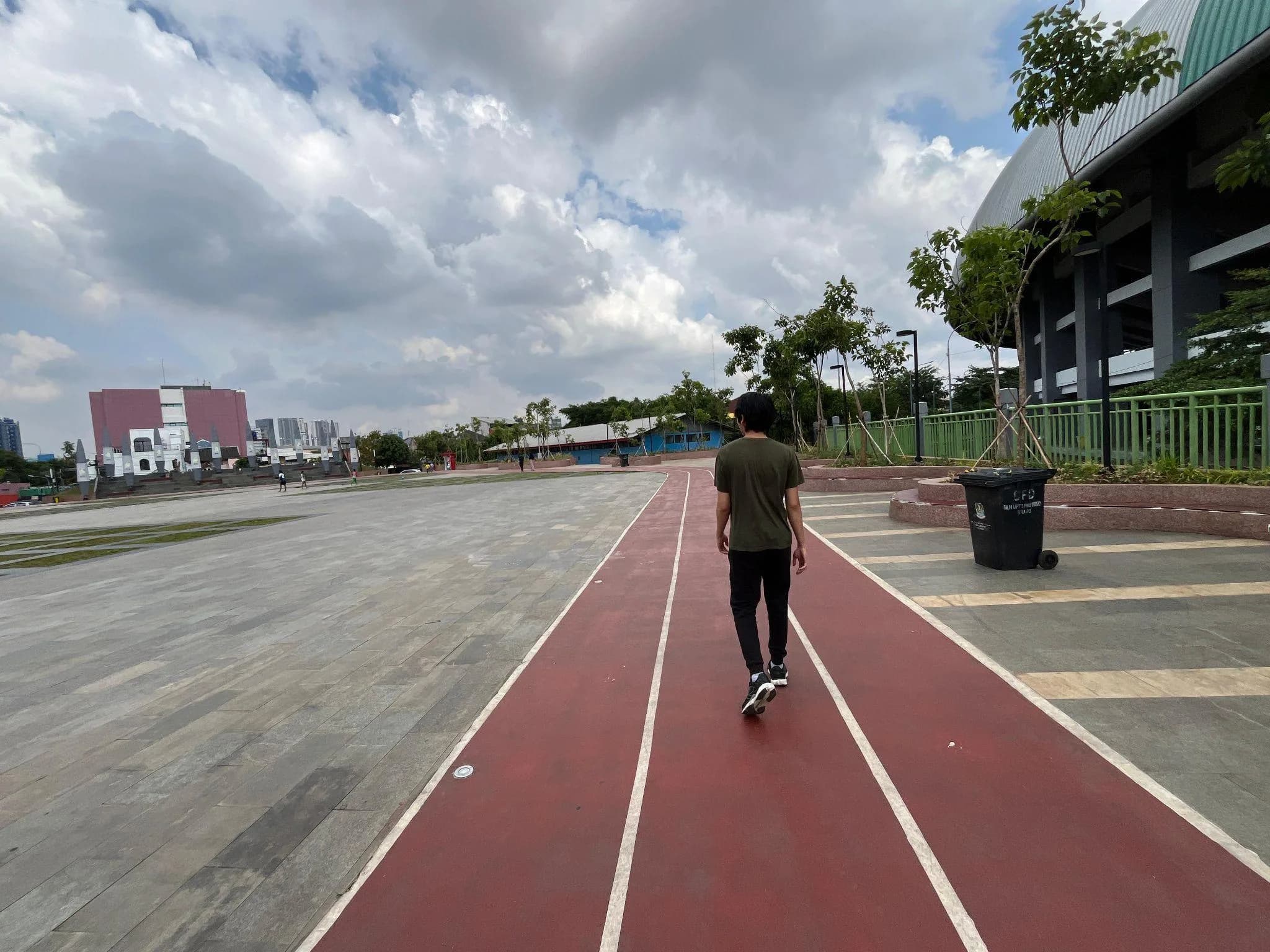
On a public track, a runner who cannot see the lane needs a guide runner: someone to hold the pace, call the turns, and keep them out of a collision. That person has to be available, fit enough, and willing. When they are not, training simply stops.
The gap
22.97M
people live with a disability in Indonesia (2023)
~4M
of them are visually impaired
11.6%
of people with disabilities exercise regularly
93%
of women with disabilities have never taken part in formal sport
Sources: Statistics Indonesia (BPS), 2023; the National Socio-Economic Survey; and a United Nations report on women with disabilities.
Twelve sessions. Fifteen pain points. Four themes.
We interviewed and observed blind and low-vision runners, then grouped what they told us. These four themes became the requirements the product gets judged against, including the ones we have not met yet.
Navigation & physical safety
Obstacles and lane edges are not detected reliably enough to be trusted at running pace.
Accessibility & feedback
A voice instruction that arrives more than half a second late is worse than none. Most interfaces are not screen-reader friendly to begin with.
Real-time performance
GPS alone drifts 5–10 metres, and training statistics do not line up between devices.
Ergonomics, power & cost
Over 350 grams, under two hours of battery, over four million rupiah. The three reasons an assistive device ends up in a drawer.
What future trials need to prove.
These are validation goals for future trials, not results from visually impaired runners.
- cue latency, camera to voice
- ≤ 0.3s
- lane and obstacle IoU in field tests, over 10,000 detections
- ≥ 80%
- of users completing a 3 km run on a public track without a guide runner, after a six-week adaptation period (2027 target)
- ≥ 70%
- reduction in collisions and trips against our initial test baseline
- ≥ 80%
Field validation with visually impaired runners has not taken place yet.
Recognition
Samsung Solve for Tomorrow
Global Ambassador
Samsung Solve for Tomorrow
Top 20 Worldwide
Samsung Solve for Tomorrow Indonesia
1st Place & People's Choice